Radial vs. Bias-Ply Tractor Tires: Which Do You Need?
August 16, 2026 · tractor tires · ag tires · farm maintenance
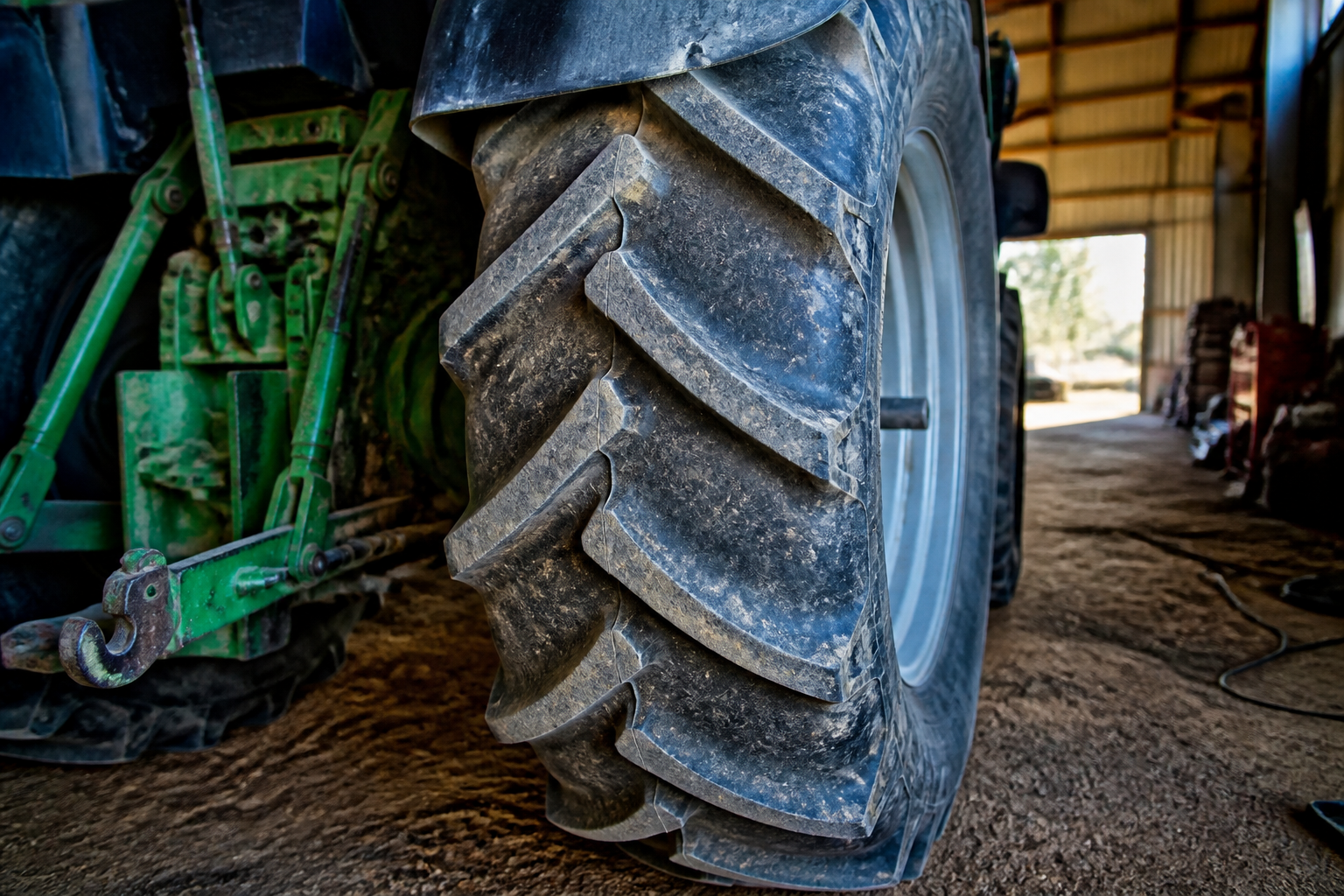
Inside the Casing: Bias-Ply Stiffness vs. Radial Sidewall Flex
When choosing replacement tractor rubber, the initial price tag often dominates the conversation. An 8-ply 18.4-38 bias-ply rear tire costs significantly less up front than a 480/80R38 radial. However, evaluating tires solely on initial purchase price ignores carcass construction, which dictates how each tire transfers torque, manages load, and wears over time.
A bias-ply tire consists of multiple nylon or polyester fabric layers laid diagonally across one another from bead to bead at a 30- to 45-degree angle. Because these plies run continuously through the sidewall and tread crown, the entire casing acts as a single, rigid unit. Deflection in the sidewall directly distorts the tread crown, lifting the outer lugs or cupping the center section.
Radial tractor tires separate the crown and sidewall functions. The carcass plies run straight across from bead to bead at a 90-degree angle to the direction of travel. Underneath the tread rubber, steel or high-strength aramid stabilizer belts wrap circumferentially around the carcass. This allows the sidewall to flex vertically under load without twisting, lifting, or squirming the flat tread footprint.
Field Traction and Soil Compaction in East Texas Clay
Casing design directly impacts power delivery in challenging soils like Smith County red clay and bottomland gumbo, particularly after heavy spring rains. Traction depends on lug contact area, dynamic rolling radius, and operating pressure.
Because a bias-ply tire relies on stiff sidewalls to support load, dropping air pressure forces the center of the tread crown to dish inward, leaving only the outer lug shoulders engaging the soil. To prevent bead slipping on the wheel or sidewall bucking, bias tires require higher inflation pressures—typically 20 to 24 PSI for standard field work. This creates a short, narrow contact patch. Under high draft loads from a disk harrow or subsoiler, high inflation causes excessive wheel slip (15% to 22%), churning topsoil into restrictive hardpan and burning extra diesel.
Radial tires maximize contact area through controlled sidewall flex. Standard radial casings operate efficiently at 12 to 16 PSI, while IF (Increased Flexion) and VF (Very High Flexion) radials run at 20% to 40% lower pressures than standard tires of the same size. When the sidewall flexes, the tread area remains flat, extending the contact patch lengthwise rather than widening it.
This elongated "snowshoe" footprint engages more tread lugs simultaneously. Dropping wheel slip down to 6% or 8% improves field speed, reduces fuel consumption per acre, and limits subsurface soil compaction that stunts crop root depth. Note that running IF or VF radial tires at ultra-low pressures requires checking your rim profile; wide DW-series rims (such as DW16L for a 480/80R38) are often mandatory to prevent bead unseating under heavy side-hill torque.
Puncture Resistance Around Mesquite, Stumps, and Thorns
While radials excel in tilled fields, certain off-field applications favor bias-ply construction. Clearing land, cutting brush, and working timber tracts expose tires to extreme sidewall hazards.
A radial tire’s soft, bulging sidewall—essential for its low-pressure footprint—exposes a thinner rubber layer protected by only one or two carcass plies. Honey locust thorns, sharp mesquite stubble, pine limbs, and hidden stumps can puncture a radial sidewall. Punctures inside the active flex zone of a radial sidewall usually render the casing non-repairable; standard vulcanized section repairs rarely hold up to constant flexing under heavy draft load.
Bias-ply tires provide uniform strength across the entire casing. Because multiple fabric layers overlap diagonally throughout the sidewall, an 8-ply or 10-ply bias tire offers high resistance to sidewall cuts, snags, and impact breaks. For a 50-to-75-horsepower utility tractor operating in heavy brush, logging environments, or rocky creeks, bias-ply construction offers dependable protection against casing destruction.
Road Travel, Ride Quality, and Tread Life on Asphalt
Transporting equipment along Highway 64 or moving between pastures via county road highlights major performance differences on hard surfaces.
At transport speeds above 20 mph, diagonal plies in a bias tire generate internal friction and heat. The tread crown squirms against the pavement, accelerating lug wear along the centerline. Bias tires also develop temporary flat spots when parked under heavy implements in cold weather, causing violent power hop and cab shake for the first few miles of travel until the casing warms up.
Radials run significantly cooler and smoother on pavement. The rigid belt package keeps the tread lugs flat against the road surface, minimizing tread squirm, while the flexible sidewalls absorb surface bumps and expansion joints. Under heavy road use, radial tread life can double that of a bias tire.
If your tractor features Mechanical Front Wheel Drive (MFWD), replacing tires requires strict attention to the front-to-rear lead/lag ratio. MFWD systems require the front tires to travel 1.5% to 4% faster than the rear tires to pull the tractor straight without driveline bind. Mixing radial tires on one axle with bias-ply tires on the other alters the dynamic rolling circumference (RC) due to differing flex rates under load. Incorrect lead/lag causes front-end hop, rapid tire scrub, and extreme gear strain in the transfer case.
The Bottom Line: Matching Tire Construction to Your Hours and Acreage
- Choose Bias-Ply if: You operate a utility tractor under 75 HP, log fewer than 150 hours annually, work in heavy brush, cut fence lines, or perform front-end loader work on uneven ground where sidewall stability is critical.
- Choose Radial if: You run an 80+ HP primary field tractor, log high annual hours, perform heavy tillage or planting, pull heavy implements over the road, or need to reduce soil compaction in hay meadows and row crops.
If you are calculating MFWD lead ratios, selecting the correct rim width for high-flexion tires, or mounting heavy-duty tubes in implement wheels, drop by Tire Barn Plus in Tyler. Bring your axle weights and machine specs, and we will get your tractor set up right. If you are out in the field right now, ask Axle on our website for instant inflation charts and fitment data.