ST vs LT Trailer Tires: Why Sidewall Stiffness Matters
August 16, 2026 · trailer tires · st vs lt · towing safety · tire load rating
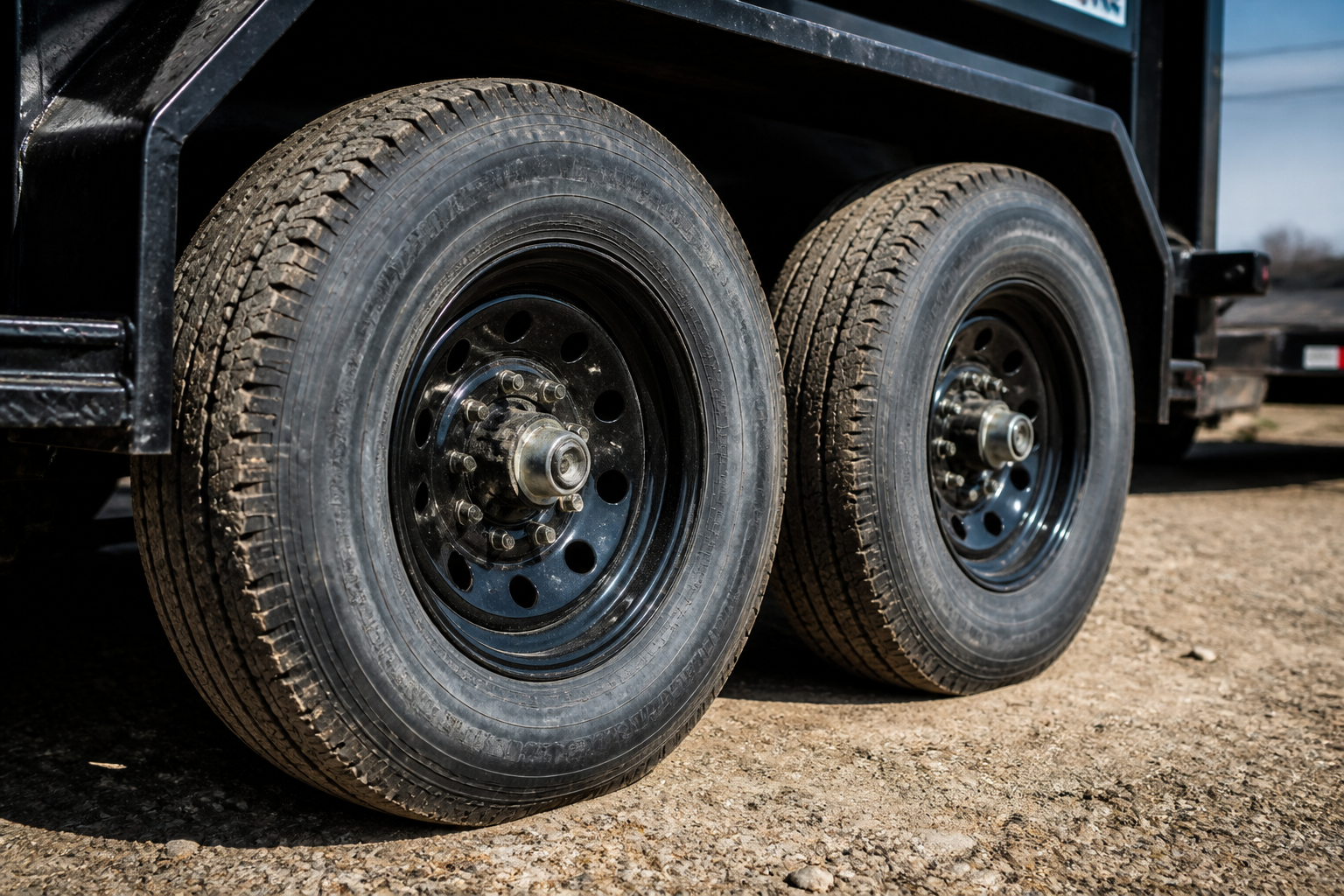
Replacing Special Trailer (ST) tires with Light Truck (LT) tires is a common attempt to prevent tire failures on stock trailers, equipment haulers, and agricultural rigs. However, substituting LT tires for ST tires without accounting for structural and load-rating differences alters rig stability, increases tread wear under axle scrub, and often degrades total carrying capacity.
Understanding tire carcass engineering, lateral stability requirements, wheel pressure limits, and dynamic heat buildup ensures your trailer remains stable under heavy loads.
ST Sidewall Construction vs. Standard LT Tires
ST and LT tires are built to distinct tire association standards because their operational demands do not overlap. An LT tire is designed for a steer, drive, or trailing axle on a motorized vehicle with a suspension engineered for ride quality and passenger comfort. Its sidewall plies are structured to flex, absorbing road impacts and maintaining tread contact while turning, braking, and accelerating under engine torque.
An ST tire mounts to an unpowered, non-steering trailer axle. Its function is to support heavy static and dynamic vertical loads while resisting severe lateral forces. To accomplish this, tire manufacturers build ST tires with stiffer polyester or steel body plies, thicker sidewall rubber compounds, and higher working inflation pressures than equivalent LT tires.
Mounting flexible LT sidewalls on a trailer with a high center of gravity allows side-to-side carcass distortion. Crosswinds, sudden lane corrections, and cornering flex the lower sidewall, causing trailer sway that cannot be dampened by standard vehicle shock absorbers.
Tandem-Axle Scrub and Turning Stress
Multi-axle trailers experience extreme lateral shear stress known as axle scrub. When a tandem or triple-axle trailer navigates a sharp radius—such as backing into a gate, maneuvering through a tight work site, or turning off sharp highway shoulders—the axles do not articulate to follow different turn radii. The front axle pulls sideways in one direction while the rear axle drags diagonally across the pavement.
This lateral scrubbing exerts severe twisting torque on the tire tread, steel belts, and bead area:
- Stiff ST Sidewalls: Keep the tread footprint flatter against the road, distributing scrub force through reinforced casing plies without excessive sidewall twisting.
- Flexible LT Sidewalls: Allow the tread area to squirm while the wheel rim tilts under torque. This repeated sidewall deformation generates intense internal heat and weakens the mechanical bond between the steel belts and the surrounding rubber matrix.
While an LT tire may show no exterior damage after repeated tight-radius maneuvering, internal belt separation from scrub fatigue frequently leads to sudden tread detachment at highway speeds.
Load Capacities, Speed Ratings, and Inflation Requirements
Standard passenger and light truck tire load calculations incorporate a safety margin for dynamic passenger loading and ride comfort. ST tires do not include this derating margin, allowing them to carry higher loads than an LT tire of identical physical dimensions and ply rating.
- ST235/80R16 Load Range E (10-Ply Rated): Standard load rating of 3,520 lbs at 80 PSI cold.
- LT235/85R16 Load Range E (10-Ply Rated): Standard single load rating of 3,042 lbs at 80 PSI cold.
Replacing four ST235/80R16 tires with standard LT235/85R16 Load Range E tires reduces total trailer axle capacity by 1,912 lbs across two 7,000-lb axles.
Historically, ST tires were capped at a maximum operating speed of 65 mph. Operating older ST tires at 70 to 75 mph under severe ambient conditions—such as East Texas summer asphalt temperatures exceeding 140°F—causes rapid thermal breakdown. Modern ST tires carry clear speed rating symbols stamped on the sidewall, typically standardizing at L (75 mph) or M (81 mph). Always verify the speed letter code alongside the numerical load index before highway operation.
Heavy-Duty Upgrades: Load Range G and 17.5-Inch Conversions
When heavy goosenecks, dump trailers, or commercial multi-car haulers exceed 10-ply ST limits, upgrades must maintain or improve structural lateral stiffness without exceeding rim tolerances.
- 14-Ply (Load Range G) Heavy-Duty ST Tires: ST235/85R16 Load Range G tires raise load capacity to approximately 4,080 lbs per tire at 110 PSI cold. This upgrade requires wheel rims explicitly stamped and rated for 110 PSI cold working pressure and 4,000+ lb load capacity. Standard 80 PSI 10-ply rims can flex, leak, or crack around the hand holes or bead seats when subjected to 110 PSI.
- Commercial 17.5-Inch Wheel Conversions: Converting from 16-inch rims to 17.5-inch commercial wheels using heavy-duty all-steel casing commercial tires (such as 215/75R17.5 Load Range H) provides maximum durability. These tires carry up to 4,805 lbs per tire at 125 PSI cold, feature steel body plies from bead to bead to neutralize scrub stress, and mount on heavy commercial steel wheels with standard 8-on-6.5 inch bolt patterns.
Cold Inflation Pressure and Valve Stem Hardware
Trailer tires must always be inflated to the full cold PSI specification listed on the tire sidewall placard. Unlike tow vehicles, where tire pressure can be adjusted for light payloads or ride comfort, lowering trailer tire pressure reduces its load-carrying capacity and causes excessive sidewall flexing.
Running an 80 PSI rated trailer tire at 60 PSI increases internal operating temperatures rapidly, leading to belt ply separation. Inflation pressures must always be checked when the tire is completely cold, prior to operation.
Additionally, higher operating pressures require appropriate valve stems. Standard rubber snap-in valves (TR413/TR415) are rated for a maximum cold pressure of 65 PSI. Operating pressures of 80 PSI or higher require high-pressure brass or stainless steel bolt-in valve stems (such as TR416 series) to prevent stem flex, ozone cracking, and high-pressure core ejection.
Whether you need to verify wheel pressure ratings, evaluate tandem axle scrub wear, or upgrade a heavy gooseneck to 17.5-inch commercial assemblies, selecting the correct tire construction prevents costly downtime and roadside casing failures. Stop by the shop to inspect your wheel and axle specifications, or ask Burt on our website for technical fitment and load capacity guidance.